
DeSoto County Court Records After a Jail Arrest
The path from arrest to a court record in DeSoto County is short but has clear steps. A person can be arrested at the scene of a crime or on a warrant the court issued in response to a sworn complaint. After arrest, that person is transported to the DeSoto County Jail and booked by the Sheriff's Office Detention Bureau. First appearance follows within 24 hours, where a judge decides probable cause, sets any bond, and may add no-contact conditions. The Office of the State Attorney, Twelfth Judicial Circuit then reviews the law-enforcement complaint. If the evidence is strong enough to prove the case beyond a reasonable doubt, an Assistant State Attorney files charges, and that filing is what creates the court record for the case.
It helps to keep two systems apart. The arrest and booking side is the Sheriff's side. Custody status, admit date, housing, and the charges the jail entered at booking show on the jail inmate records roster, and booking photos appear on the jail mugshots page. The court record is the Clerk's side. It holds the counts the prosecutor actually filed, the case number, and the disposition. Booking charges and filed charges are not always identical, so after an arrest you often need to read both the jail entry and the court file to see the full picture.
How to Find DeSoto County Court Records After an Arrest
Formal court charges are kept by the Clerk of the Circuit Court, not the jail. DeSoto County Clerk Nadia K. Daughtrey maintains court files at 115 East Oak Street, Room 101, in Arcadia. The Clerk's records-search page links to the statewide Civitek online court records system, where you can pull up a case by name or case number. The jail roster is the fastest source for the booking charge and current bond, but once the State Attorney files or amends a case, the Clerk docket becomes the authoritative source for filed counts and disposition.
You can start that search straight from the DeSoto County Clerk records search page, which carries a short disclaimer before it sends you to the court records portal.
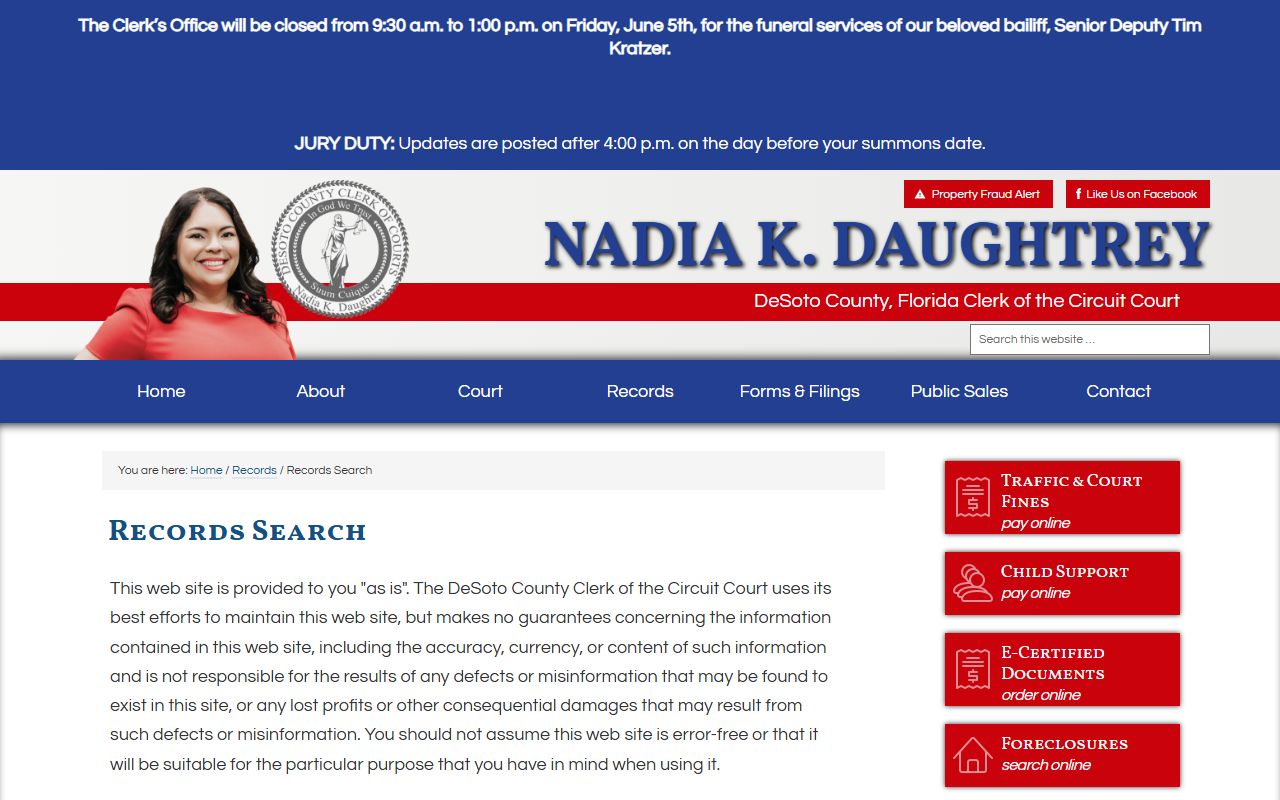
That page warns that online records are provided as is, with no guarantee of accuracy or currency, then hands you off to Civitek for the actual case lookup. To work a case after an arrest, follow these steps.
- Open the DeSoto Clerk records-search page and click through to the Civitek online court records search for DeSoto County.
- Choose the Public access option, then search by the defendant's name or the court case number.
- Open the matching case and read the charge list the State Attorney filed.
- Check each charge's statute, level, and current status, then note the next court date and any disposition.
The Civitek access screen is where you pick how you enter the system. Anonymous Public access is enough for most lookups, while the other options need a login.
The Civitek access page for DeSoto County lists four ways in and a notice about the rule that governs them.
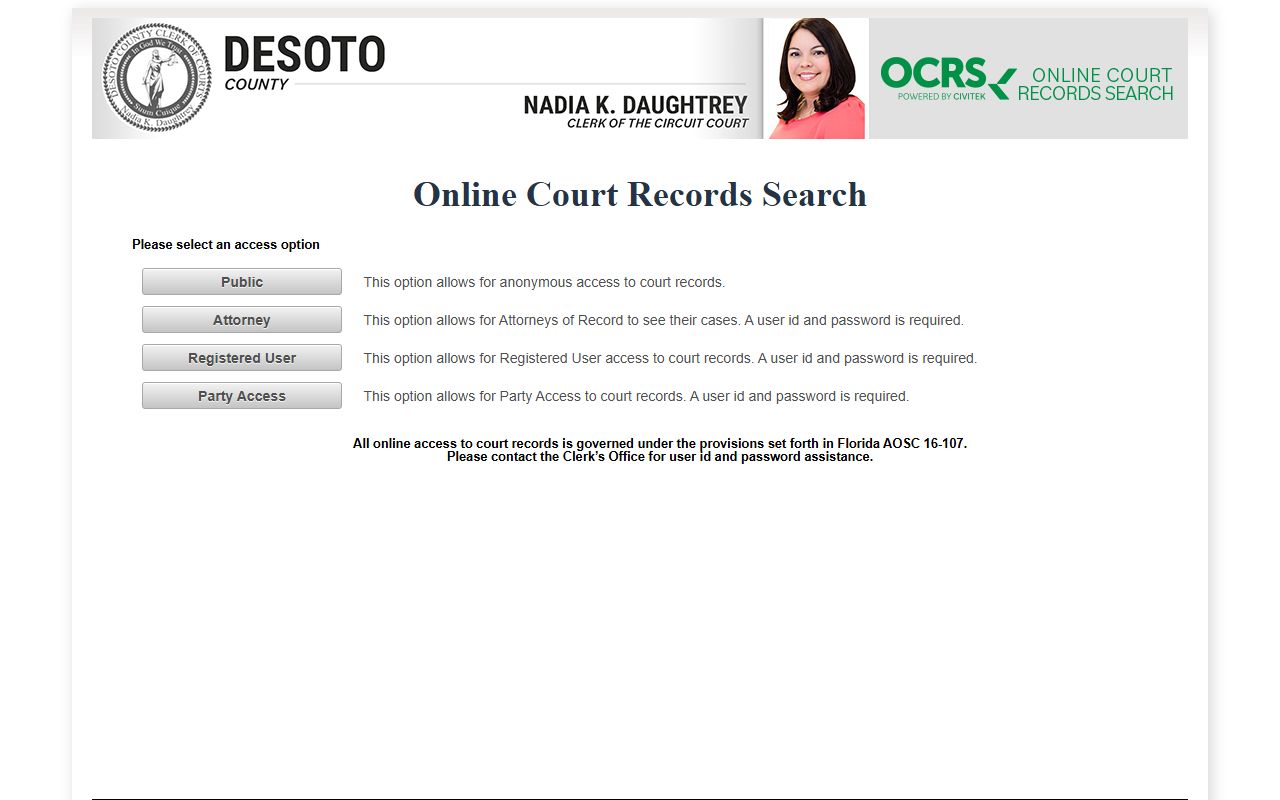
All online access to these court records is governed by Florida AOSC 16-107. If the online search does not answer your question, email CustomerService@DesotoClerk.com or call the Clerk at 863-993-4876. The office is open Monday through Friday, 8:30am to 4:30pm, and closes from 12 to 1pm for lunch.
| Access Option | Login | What It Allows |
|---|---|---|
| Public | No login | Anonymous access to court records. |
| Attorney | User ID and password | Attorneys of record can view their own cases. |
| Registered User | User ID and password | Expanded registered-user access to court records. |
| Party Access | User ID and password | Access for a party to the case. |
Note: all four Civitek access levels operate under Florida AOSC 16-107, and the Clerk's office handles user ID and password assistance for the login options.
How Court Charges Get Filed After an Arrest
Booking and the court charge are two separate events. At booking, the jail enters the arrest charge into its record. The court charge begins only when the State Attorney files a charging document with the Clerk. Florida practice uses three main types. A complaint is the initial accusation, often a sworn complaint from law enforcement that can also support a warrant. An Information is the formal charging document an Assistant State Attorney files for most felonies once the evidence supports prosecution. An Indictment comes from a grand jury and is reserved for the most serious offenses. The DeSoto jail profile's Court Type field, such as "Felony - 12th JC," points toward the right court level, but the filed charging document is what actually opens the court case.
| Complaint | Information | Indictment | |
|---|---|---|---|
| Filed By | Officer / Prosecutor | State Attorney | Grand Jury |
| Common For | Misdemeanors and initial charges | Most felonies | The most serious felonies |
| Starts | The accusation | The felony court case | The felony court case |
The Clerk separates the case by level. The felony division handles intake, court dates, and final disposition for crimes that can carry a Florida Department of Corrections sentence, which the Clerk describes as one year and one day up to life. Misdemeanor and criminal-traffic matters go to county court, where the maximum penalty is 11 months and 29 days in the county jail.
The Clerk's felony page is a useful reference for how a felony case is tracked and what it can cost a defendant to file motions on their own.
You can review that on the DeSoto County Clerk felony case page, which also notes the prison sentencing threshold.
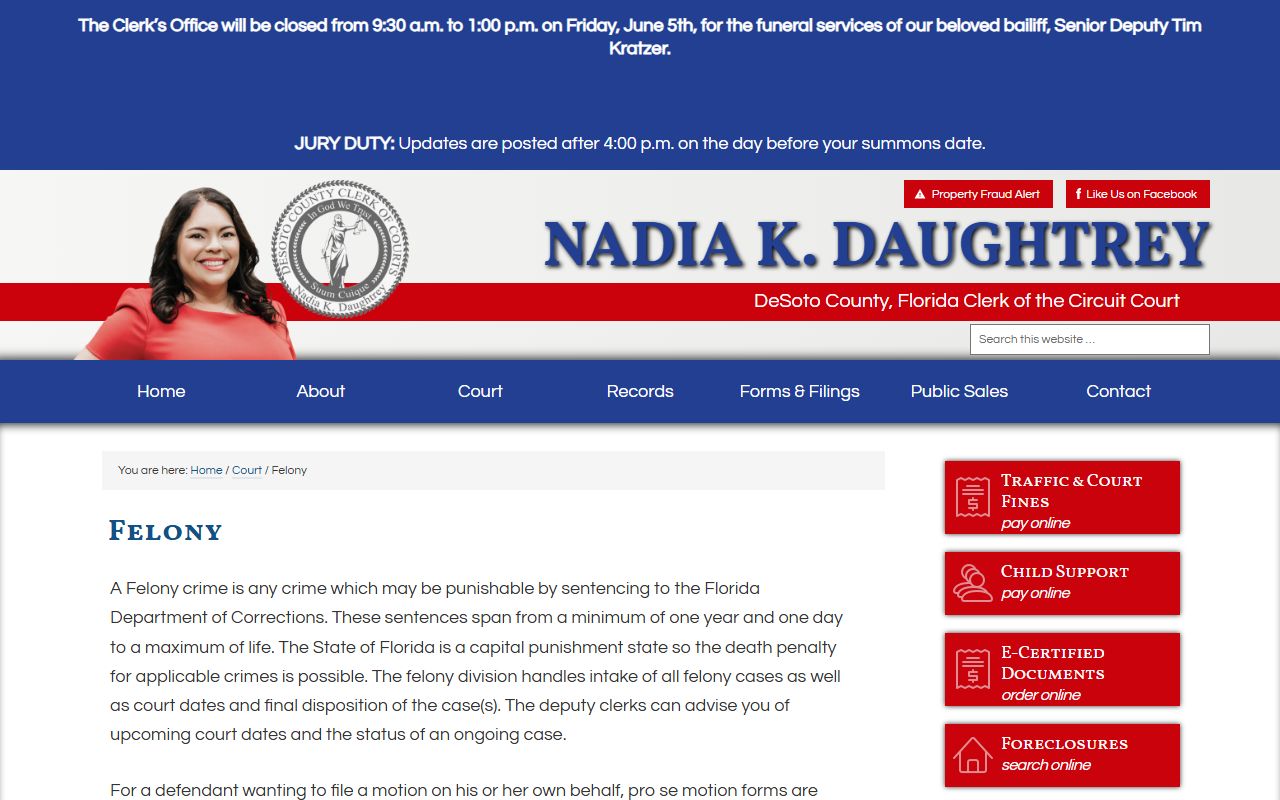
That page also lists a $5 fee for a pro se motion, meaning a motion a defendant files without a lawyer. It explains why a person who is in the DeSoto jail after a felony arrest can later move off the county roster and into Florida Department of Corrections custody once the court enters a prison sentence.
Charge Status in DeSoto County Court Records
Charges move as a case develops. The State Attorney can add, reduce, amend, dismiss, or decline counts after reviewing the arrest. Because of this, the charge listed at booking on the jail roster can differ from the charge the prosecutor finally files in court. A jail profile may even show an arrest charge and a first-appearance court date before any filing decision is made. If no court case appears soon after a booking, that does not always mean the charges were dropped, so it is worth checking the Clerk docket again after filing. The terms below show up often in DeSoto court records.
| Status | What It Means |
|---|---|
| Pending | The charge is filed and the case is open, with no final outcome entered yet. |
| Amended / Reduced | The prosecutor changed the charge, often to a lower level or a different count than the one entered at booking. |
| Dismissed | The court ended the charge, so it is no longer being prosecuted. |
| Nolle Prosequi | The State Attorney chose not to pursue the charge, dropping it before a verdict. |
Note: the online docket is not always the final legal record, so confirm certified copies, sealed files, or confusing entries directly with the Clerk's office.
Bond and Release After a DeSoto County Arrest
Bond is usually set at first appearance, within 24 hours of arrest, when the judge finds probable cause and decides whether a bond should be set and how much. You can find a person's bond by searching the jail Inmate Search and reading the charge and bond fields at the bottom of the record, or by calling the DeSoto County Jail at 863-993-4710. Cash and surety bonds are posted through the jail lobby on the east side of the DeSoto County Sheriff's Office. There is no online bond-payment channel posted by the Sheriff's Office, and DCSO asks callers to allow an hour for release processing before checking on someone's release status.
| Bond Type | How It Works |
|---|---|
| Cash Bond | The full bond amount is posted in cash or an accepted payment form. |
| Surety Bond | A licensed bail bond agent posts the bond on the person's behalf. |
| PR / Own Recognizance | Release on a written promise to appear, listed in DCSO records as ROR, with no money posted. |
| No-Bond Hold | A hold where paying money does not free the person; the sample jail record showed "HOUSE FOR OTHER AGENCY" with No Bond. |
A hold is the key thing to watch. Even when a local DeSoto charge looks bondable, a hold for another agency, a detainer, or an out-of-county matter can keep someone in custody. DCSO release categories include transfers to the Department of Corrections and holds for other agencies, so federal, immigration, probation, or out-of-county holds should be verified with the jail or the agency that lodged them.
Warrants That Lead to a DeSoto County Arrest
A warrant is one of the two ways an arrest happens. A court can issue an arrest warrant on a sworn complaint, and the State Attorney can request a capias once a case is filed. A bench warrant usually follows a missed court date or a court order. Once a warrant is served and the person is booked, that person normally shows up in the DeSoto County Jail roster while held. Before service, a warrant alone does not put anyone on the roster.
DCSO does not publish a full searchable active-warrant database, but it has a Records/Warrants Unit within its Support Bureau, and you can call the office at 863-993-4700 or 863-993-4710. For selected subjects, check the DCSO wanted persons page, keeping in mind a most-wanted listing is not a complete warrant list. For a broader official search, the Florida Department of Law Enforcement runs a statewide wanted persons search. Local bench warrants and capias events can also appear in the Clerk's court records before any public wanted listing does. Anyone who believes they may have a warrant should verify it with the court or sheriff and arrange an appearance or bond as directed, since there is no online way to clear a DeSoto County warrant.
Charges vs. Convictions in Court Records
Being arrested and charged is not the same as being convicted. A charge is an accusation that the State Attorney files; a conviction is what the court enters after a verdict or a plea. Jail roster entries are booking charges and custody data, while the Clerk docket tracks the formal case and its disposition. A charge stays a charge unless and until the court enters an adjudication.
| Charge | Conviction | |
|---|---|---|
| Stage | Accusation | Verdict or plea |
| Burden of Proof | Probable cause | Beyond reasonable doubt |
| Public Record | Yes | Yes |
Sealed vs. Expunged Arrest Records
After a dismissal or an eligible disposition, a person may ask the court to limit public access to an arrest record. Florida draws a line between sealing and expunction. A sealed record is hidden from public view but still exists and stays available to certain agencies. An expunged record is treated as though it never happened, and Florida Statutes section 943.0585 governs court-ordered expunction of criminal-history records. Eligibility is set by Florida law and is narrow; sealing and expunction each have their own conditions, and a single prior conviction or certain disqualifying charges can rule a person out.
| Sealed | Expunged | |
|---|---|---|
| Visibility | Hidden from public | Destroyed / treated as never existed |
| Law Enforcement | Limited access | Very limited |
| Eligibility | Set by Florida law; generally requires no conviction on the charge and no disqualifying history | Set by Florida Statutes 943.0585; typically follows a dismissal or sealed record and stricter conditions |
If a record is sealed or expunged, you bring the court order to the originating agency to update its files. The State Attorney handles filing and victim-process questions; the court or an attorney handles eligibility advice.
Background Check Considerations
Court records found through the Clerk or Civitek are useful for personal lookups, but they are not the same as a regulated background check. A formal employment, tenant, or credit screening must follow the federal Fair Credit Reporting Act and run through a licensed consumer reporting agency. Florida public records open broadly under sections 119.011 and 119.07, yet basic open access does not turn a casual record search into an FCRA-compliant report.
Important: This website is not a consumer reporting agency under the FCRA, and nothing found here may be used for employment, housing, credit, insurance, or any other FCRA-regulated decision.
Restricted Court Records After an Arrest in DeSoto County
Florida opens most arrest and court records, but exemptions still limit what the public sees. Florida Statutes section 119.071 lists redactions and exemptions that can apply after an arrest. Juvenile records are restricted. Active criminal investigative information can be withheld while a case is open. Victim information is protected under specific exemptions, and certain personal or safety-sensitive details are redacted. Records that a court has sealed or expunged drop out of public access as well. Because of these limits, an online search may not show everything, so the Clerk, the State Attorney, or the Sheriff's records channel is the place to confirm what is and is not available in any single case.